
Before the World Tells Them Who to Be
Why I created the Magic Mirror, and why I believe the conversations our children have with themselves may be some of the most important ones we shape.
There is a voice my children will hear more than mine. More than their teachers’, their friends’, their coaches’, or eventually, their partners’ and bosses’. It is their own. Once I really understood that, I couldn’t stop thinking about what that voice would sound like as they grew up.
What will it say when they fail? When they look in the mirror and don’t like what they see? When they walk into a room and wonder if they belong there? When someone tells them they aren’t good enough, or when they have a dream that feels impossibly big? Will the voice inside say, You can do hard things. Try again. You belong here. I believe in you. Or will it say something else?
That question is at the heart of why I created the Magic Mirror. But the story really begins with me becoming a mother.
After having my son, I experienced a year of debilitating postpartum depression. It was one of the darkest periods of my life, and in many ways, it forced me to confront my own mind for the first time. I had spent my life learning how to achieve, how to perform, how to take care of other people. I had a Master’s in Special Education and had spent years teaching children. I understood development. I understood learning. And yet, at one of the most vulnerable points of my own life, I realized how little I understood about the way I spoke to myself.
As I worked to find my way back to myself, I began doing something incredibly simple. I started looking at myself in the mirror and speaking differently. I used affirmations. I visualized the person I wanted to become. I became intentional about the thoughts I repeated and the stories I allowed myself to believe. Slowly, my relationship with my own mind began to change.
As I started to feel like myself again, one question kept coming back to me: Why did I have to wait until I was struggling to learn how to do this? And even more importantly, why are we waiting to teach our children?
As an educator, I knew how formative the early years are. Young children are constantly building associations, patterns and beliefs about themselves and the world around them. They are learning language, relationships, what love feels like and where they belong. But they are also beginning to learn something we talk about far less: who they believe themselves to be.
I became fascinated by the possibility of treating that inner relationship as something worthy of teaching from the very beginning. Not because I believe we can protect our children from every hard thing. We can’t. They will be left out. They will lose. They will make mistakes. They will encounter people who misunderstand them. There will be moments when they question themselves and moments when we, as parents, desperately wish we could step in and take the hurt away.
But the goal was never to raise children who never struggle. The goal was to help raise children who know how to come home to themselves when they do.
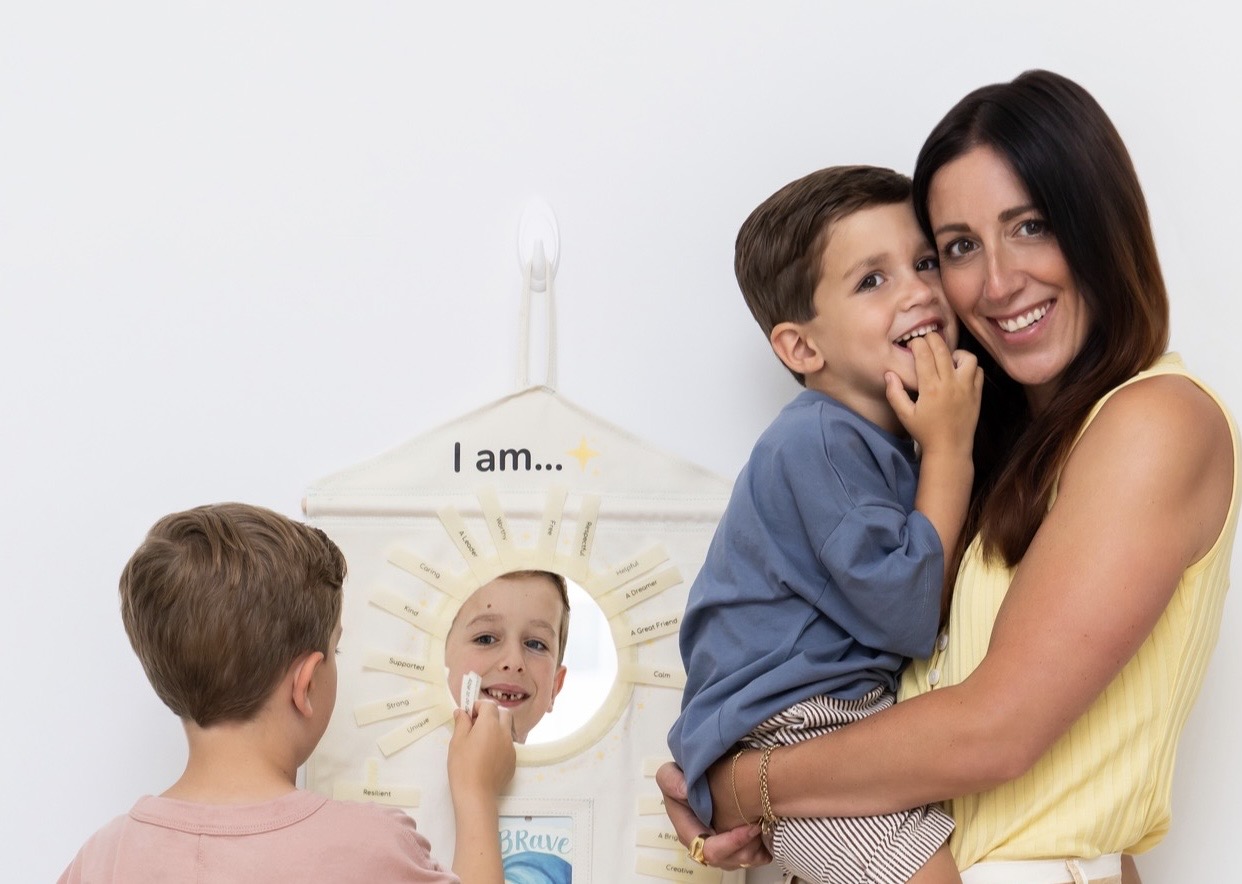
That idea became the beginning of the Magic Mirror. I wanted to take concepts that can feel abstract to a young child, like self-belief, emotional awareness, visualization and positive self-talk, and turn them into something tangible. Something they could see, touch and practice alongside the people who love them most.
The ritual itself is intentionally simple. A child chooses an affirmation, places it on the mirror, looks at their reflection and says the words. Then a parent or caregiver helps bring those words into their real life. Maybe the affirmation is ‘I am brave’, and it leads to a conversation about walking into preschool without Mom. Maybe ‘I am kind’ comes back later when they notice someone sitting alone. Maybe ‘I am capable’ becomes the language they reach for when something feels hard.
That is the part that matters most to me. The Magic Mirror was never meant to simply hang on a child’s wall. It was created to start conversations. To create a small daily ritual between a child and themselves, and between a child and the person raising them. Because the hope is not that a child memorizes a collection of positive phrases. The hope is that, over time, those ideas become part of the language they use to understand themselves.
I think about this constantly as a mother. There will come a day when my boys won’t look to me first for the answer. They will walk into rooms I cannot walk into with them. They will make decisions I cannot make for them. They will experience heartbreaks I cannot prevent and opportunities I cannot manufacture. That realization can be terrifying as a parent, but it has also given me tremendous clarity about what I believe my job actually is.
My job is not to control the life ahead of them. My job is to help build the person who will meet it.
That belief has grown far beyond one product. It has become the vision behind Mindchild and, in many ways, the work I feel I am here to do. I don't want mental and emotional well-being to be something our children discover only after they are struggling. I want it woven into childhood. Into bedrooms and breakfast tables, classrooms and car rides, bedtime conversations and the ordinary moments that quietly shape who a child becomes.
I want children to grow up understanding that their minds are something they can know, care for and intentionally shape. I want them to learn that they can notice the way they speak to themselves, question a thought instead of automatically believing it, imagine something bigger for their lives and understand that who they are is not determined by the loudest voice in the room.
Sometimes I imagine my children years from now, long after the Magic Mirror has come off their bedroom wall. They will be adults with complicated lives of their own. The world will have given them plenty of reasons to question themselves by then. Maybe one of them will be standing in front of a mirror during a season when nothing feels certain. I won’t necessarily be there to tell him what I believe about him.
But maybe somewhere underneath all of the noise, he will hear another voice. His own.
And maybe it will sound familiar.
I am worthy. I am capable. I am enough.
Not because saying those words as a child guaranteed him an easy life. It won’t. But because long before the world had a chance to tell him who he should be, we gave him the space to begin discovering who he already was.
That is why I created the Magic Mirror. And that is the future I hope we can create for our children.
Magic Mirror, CultivatED Group
← Back to The GuidebookComments & Questions
Leave a comment or ask a question below.